The LASIK Procedure - A Step-By-Step Failure


Article created by-Halvorsen Upton
The primary step is to meet your physician. They will certainly do examinations as well as ensure your eyes are healthy and balanced enough for LASIK.
They will put decrease in your eyes to numb them as well as will certainly use an eyelid speculum as well as suction ring to maintain you from blinking. You will certainly feel pressure and your vision will get dim or black.
Pre-Operative Procedure
After a short check-in with the receptionist and signing authorization kinds, you will be led into the treatment room. Throughout this time around, your eyes will be checked out for proper healing as well as to make certain that LASIK is right for you. Your ophthalmologist or eye doctor will check the form of your cornea and also your pupil size, and also will look for dry eye signs that can interfere with your post-surgery vision.
try this out will after that use numerous numbing eye goes down to guarantee you do not really feel any pain throughout your procedure. A sterilized drape will be positioned over your eye to shield it from microorganisms as well as other particles. Then, utilizing a lid speculum tool, your eyelid will be held open with a suction ring, and also a protective flap in the cornea will be created.
This flap will after that be folded back over itself and also bonded securely without the requirement for sutures. LASIK will improve your cornea so light can enter the eye correctly and be focused on the retina, where it is after that exchanged nerve signals that are read as visual photos by the brain.
Intra-Operative Procedure
The first step in the LASIK treatment entails positioning special eye goes down into your eyes to numb them. Your doctor will after that put a suction ring and also eyelid speculum to keep your eye open as well as avoid you from blinking during therapy.
Throughout the LASIK treatment, your doctor will develop a slim flap in the cornea making use of a tool called a microkeratome or a femtosecond laser. The cornea is the clear front part of your eye that bends light so it can get to the retina as well as be taken visual photos by the brain.
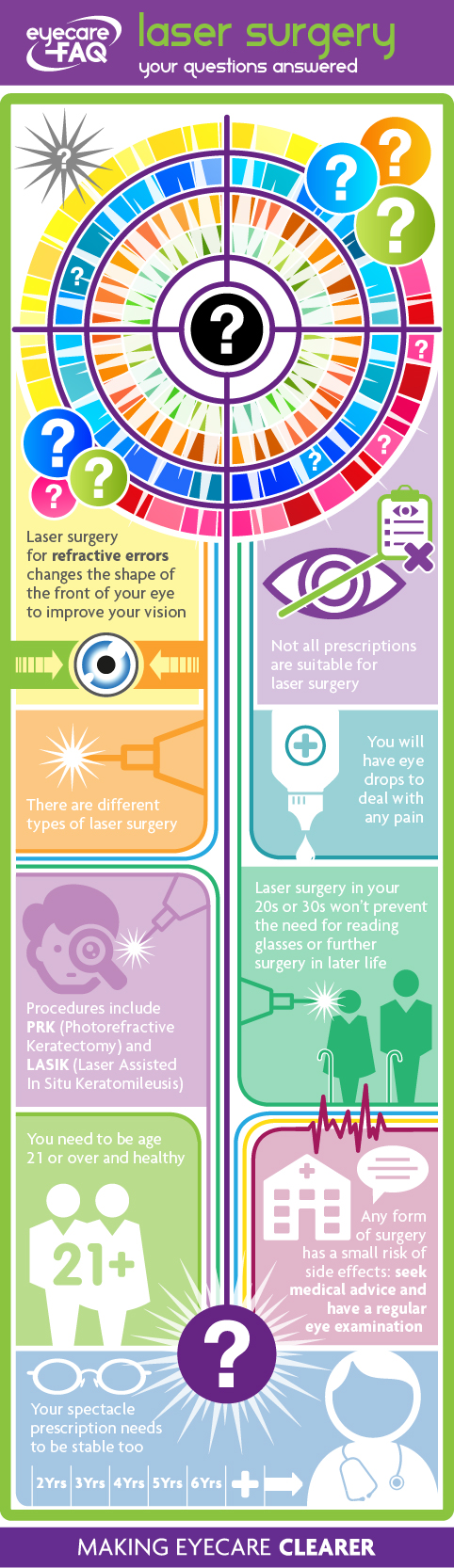
LASIK can help deal with refractive errors that trigger nearsightedness (myopia), farsightedness (hyperopia), and astigmatism. Nonetheless, it can't treat presbyopia, which is the age-related loss of close-up vision that brings about requiring bifocals or checking out glasses. This is due to the fact that LASIK only improves the cornea, not the lens. You may additionally not be a great prospect for LASIK if you have specific clinical problems or health problems, such as unrestrained diabetic issues.
Post-Operative Treatment
After the topical anesthesia wears away, your surgeon will ask you to explore an unique light as well as trigger an accuracy tool that folds up back a thin flap of the cornea. This enables the surgeon to improve the cornea to remedy your vision. The flap is after that put back in place where it naturally sticks, removing the need for sutures.
During the procedure, the surgeon utilizes an excimer laser to reshape the cornea. https://www.verywellhealth.com/best-vision-insurance-5104718 are made to remove refractive mistake and supply clear, crisp vision. The iLASIK procedure additionally integrates wavefront technology, which analyzes your eye's optic system as well as steps complex aberrations such as trefoil, coma, tetrafoil, and also round aberration, all of which trigger weakened vision that can not be remedied with typical glasses or contact lenses.
Your surgeon may prescribe eye drops and painkiller. It is normal to experience itching or a gritty sensation in your eyes after the surgical treatment, however these signs and symptoms need to subside as the eye drops kick in. Make find more to utilize the preservative free eye goes down as guided and stay clear of rubbing your eyes.
Follow-Up
LASIK transforms the form of your cornea to improve how light hits your retina and also focuses correctly. The light is then converted into nerve signals that are sent out to your mind and interpreted as visual pictures. In many cases, LASIK reduces or eliminates the demand for glasses and calls.
Your medical professional will certainly place anesthetic eye decrease in your eyes to stop pain or discomfort throughout the procedure. Next, she or he will make use of an instrument called a lid speculum to hold your eye open while she or he creates a slim flap on the cornea utilizing an automated device called a microkeratome or a femtosecond laser. The flap is after that peeled off back, exposing the corneal cells underneath for laser reshaping.
As soon as the reshaping is full, the doctor will carefully change and secure the flap. Then, your physician will certainly test your vision. You may experience some fuzzy or hazy vision quickly after the procedure, however this should clean up within a couple of days.